Tuesday, November 9, 2010

Chance

When I typed the word "chance" into wikipedia I was offered a few different choices. I decided to check out the word "randomness" in relation to chance.

Random is defined as "Having no definite aim or purpose; not sent or guided in a particular direction; made, done, occurring, etc., without method or conscious choice; haphazard" (wikipedia.org).

I feel like this is the most important factor in my work. Everything I have been doing relates back to chance. This also relates back to my haiku entry where I discussed the terms ichi-a and ichi-go, roughly meaning never before, never again. When I go out in nature I realize that everything I am seeing is new and I will never be able to see it that way again. In a way, my photographs are a way of preserving these special moments and showing my viewers something that they would have probably never experienced.

"In ancient history, the concepts of chance and randomness were intertwined with that of fate" (wikipedia.org). I feel like a lot of my work is related to this idea as well. All of these different concepts are intertwined with each other and hopefully I am able to communicate those ideas with my images.

Randomness by Deborah J. Bennett. Harvard University Press, 1998.

Monday, November 8, 2010

Daniel Sroka

Daniel Sroka has been a professional artist for the past decade "developing a new approach to nature art through his own unique style of abstract macro photography" (danielsroka.com). He spent 20 years as a graphic designer before making the switch to fine art photography. He was also Yahoo's first creative director. In addition to his fine art photography he also maintains a photography business online, doing weddings etc. He is represented by the Karin Newby Gallery.

He creates "abstract, dream-like images out of the simple elements of nature, such as leaves, sticks, flowers, and seeds. He finds most of his subjects as he walks through the parks and gardens near his home, collecting the sticks and leaves that have fallen to the ground. In his hands, these overlooked natural objects reveal their complexity and subtlety" (danielsroka.com).

When I first saw this artist's work I was blown away by our similar styles and our similar artistic goals. Upon further research I discovered that many of his shots are done in the studio. That made me feel a little bit better. While he focuses mainly on one object in nature to glorify I usually focus on an overall landscape or groups of objects in the environment. In a lot of ways his work is even more abstracted than mine. It was nice to see an artist doing similar things and it was also nice to know that even though a lot of our ideas are the same, we're able to do different things and make completely different work.


http://hammermarks.wordpress.com/2009/07/01/july-artist-of-the-month-daniel-sroka/

http://www.danielsroka.com

http://www.karinnewbygallery.com/

Wednesday, November 3, 2010

Graduate School: MICA

MICA was my second choice for potential graduate schools, mostly because of their diverse masters programs. I am really interested in the M.F.A. in photographic and electronic media as well as the M.F.A. in community art and the multidisciplinary program. What I like about the photography and electronic program is the mixing of all different kinds of photographic and film/video mediums. Students are encouraged to experiment with all different types of media, old and new, and even mix them. They also have state-of-the art equipment and labs for any kind of work you want to do. I am also intrigued by the community art program. I have always been really interested in public art like murals or functional pieces. With the community art program you get to work with kids as well developing art pieces for public view. The multidisciplinary program is a lot like the first program where students don't have a specific track in any of the arts, you just work with the materials and mediums that you want to work with in order to get your work done. Each student is given their own studio and access to all of the studios and equipment. Plus, this school is located in my home state in Baltimore. Baltimore has always been one of my favorite places and is quickly becoming a big force in art as well as music. What really jumped out at me first with MICA was the M.F.A. in Community Arts. I've never really seen that kind of program available at other schools. It is definitely something I would like to pursue in the future.

Craig Kalpakjian (faculty)
He is a faculty member in the Photographic and Electronic Media department. He has exhibited work all over the world, most recently in Paris. He was born in 1961.

Shannon Heaton (student)
She is a grad student in the Photographic and Electronic Media department. This is work from her MFA Thesis Exhibition 2, in 2009.

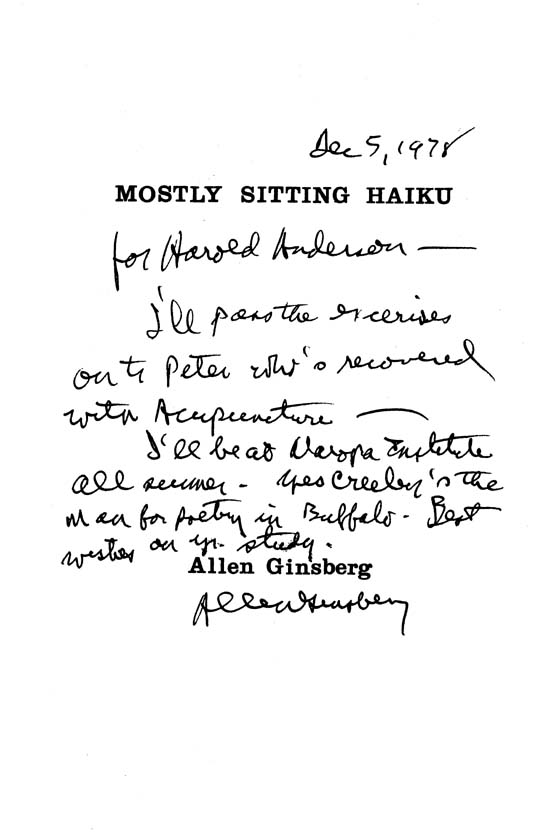
Haiku

Recently in my Religions class, we had a guest speaker whose topic for discussion was haiku. Everything he described about this particular form of poetry seemed to fit what I'm trying to do artistically. There were two words he used, ichi-go and ichi-a. Which essentially means, never before and never again. That's the whole point of haiku. To lose oneself in nature and actually appreciate everything that is around you and realizing that whatever you are seeing then has never happened before and it never will again. Every experience is unique. Nothing is ever the same. Ever. The whole point of writing a haiku is to forget your ego just for a minute, to heal yourself. To really appreciate and enjoy what you're surrounded by. Hearing the guest speaker was really inspiring. He told us we should practice writing haiku's everyday. We would be surprised what we could come up with. I think it's a really good idea, something I want to try. I think about the final presentation of my work and I think about possibly incorporating haiku's that I write while I explore and meditate and get lost in nature. I think that would be really interesting to incorporate all of these different aspects because though they are different at their core they are all the same.


  "Haiku can help kids and adults alike to connect to the world of nature and people-to see the interconnectedness of our small world, perhaps even making a step toward peace" (Patricia Donegan).

"Kawahigashi Hekigoto carried Shiki's reform further with two proposals
  1. Haiku would be truer to reality if there were no center of interest in it.
  2. The importance of the poet's first impression, just as it was, of subjects taken from daily life, and of local colour to create freshness"(toyomasu.com).
Vachss, Andrew H. Haiku. New York: Pantheon, 2009. Print.


Graduate School: Rochester Institute of Technology

Located in: Rochester, NY

One of the main reasons why I was interested in RIT was because it has a whole school devoted to photography and imaging arts. Within the school of photographic arts and sciences there are multiple B.F.A. and M.F.A. programs devoted to different types of photography such as, advertising, fine art, and photojournalism. It's kind of amazing to see how many different options there are for photography students at this school. The M.F.A. program is devoted to imaging arts. The program focuses on traditional and digital ways of image making, as well as some new media. Another thing I also really like about the program is the fact that RIT is all about getting you and your work out there. Part of the M.F.A. program is all about getting internships and assistantships. You get to focus on your work as well as getting professional experience in museums, galleries, or with other photographers. What makes this school a really good match for me is the fact that it's so open. You are given the tools to do whatever you want, whether it's photography or film or any type of medium. RIT still uses a traditional darkroom as well as top of the line computer labs, so you can work in any style you want. Plus, there are over 40 faculty just in the M.F.A. department, so there is room for a lot of diversity. The most unique aspect to RIT is how they incorporate traditional, alternative, and digital photography into their program. I really appreciate the fact that they still use a traditional black and white and color darkroom. Not many schools still use darkrooms and the fact that this school has both black and white and color stands out to me.

Elliot Rubenstein (faculty)
He has been an educator in the Fine Art Photography program at RIT since 1976. He completed graduate school at the Visual Studies Workshop SUNY, Buffalo in Rochester. The main focus of Rubenstein's work is the "problematic interrelationship between nature & culture and its historical impact on the development of landscape art" (elliotrubenstein.com). He received a National Endowment of Humanities, primarily for his research in the tradition of the sublime in the American West. He lived with an Aborigine group and was given permission to explore and photograph sacred sites of ancient and contemporary rock art. In the last decade he has undertaken seven excursions into the deep jungles of Latin and South American in search of primitive art.

Emily Winton (student)
She attended the University of South Florida for photography and then moved to NY to receive an M.F.A. in the fine art photography track at RIT.
Monday, November 1, 2010

Michael Kessler

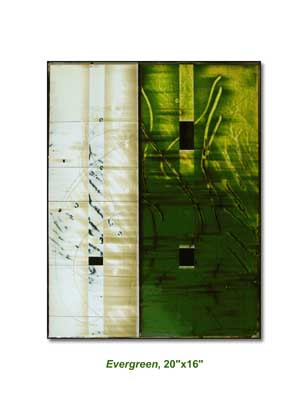
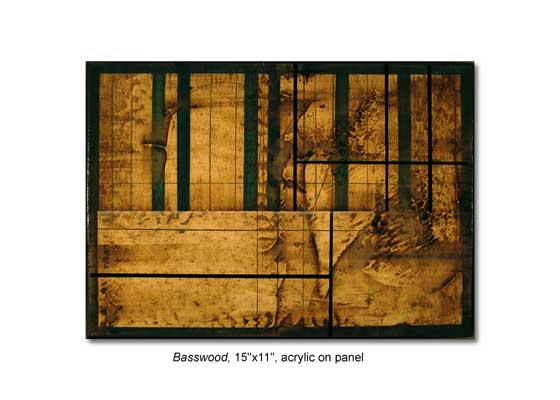
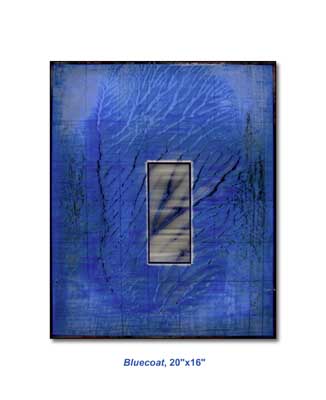
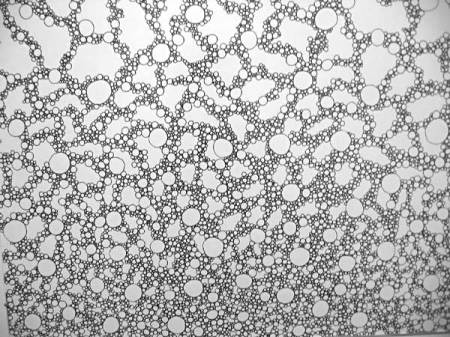
Michael Kessler was born in Hanover, PA in 1954. He received a B.F.A. from Kutztown University. He currently lives and works in Santa Fe, NM. In 1977 he participated in the Whitney Independent Study Program in the Whitney Museum of American Art in New York. He also received a Pollock/Krasner Award for painting in 1992. He is known for his abstract paintings of nature beneath glossy finishes. His work is currently on display in over 24 museum collections all over the U.S. His most well known works contain organic backgrounds layered with squares and rectangles shot through with acrylics, varnishes, and gesso.

"Kessler seems to feed off his colors'saturation; when he departs from it, as in the less exhilarating ecru etudes, he loses his bearings. It is as if he senses that in the great battle his work chronicles, nature always wins; the best humanity can do is live—and paint—with intensity"(ARTNews 2005).


"It is an unlikely updating of Hans Hofmann, this skillfully modulated push-and-pull between the polar drives to surmount nature and to surrender to it, rather like ancient ruins, toppled and overgrown with vines. Kessler’s ruins are his immaculate geometries, cancer-eaten by lichenlike tendrils that spread across and penetrate into the thickly built-up paint. There is something poignant in this" (ARTNews 2005).


When I first started formulating ideas for my project I took a lot of inspiration from all different kinds of art. Painting as well as film were two of my biggest influences. I enjoy Kesslers' view of nature and how abstracted it is. When you first look at the pieces it is hard to tell what you're looking at sometimes and then you realize you're looking at a tree branch or a leaf. That's what I'm trying to accomplish with my images. And I think in some pieces that idea is stronger than others. In the second quote the critic describes the struggle to overpower nature or surrender to it. I enjoy the idea of surrendering to nature and letting yourself get lost in it and overall just appreciating the world around you that you take for granted.


http://www.geoform.net/features/features_kessler.html

www.allentownartmuseum.org

http://michaelkessler.com/